
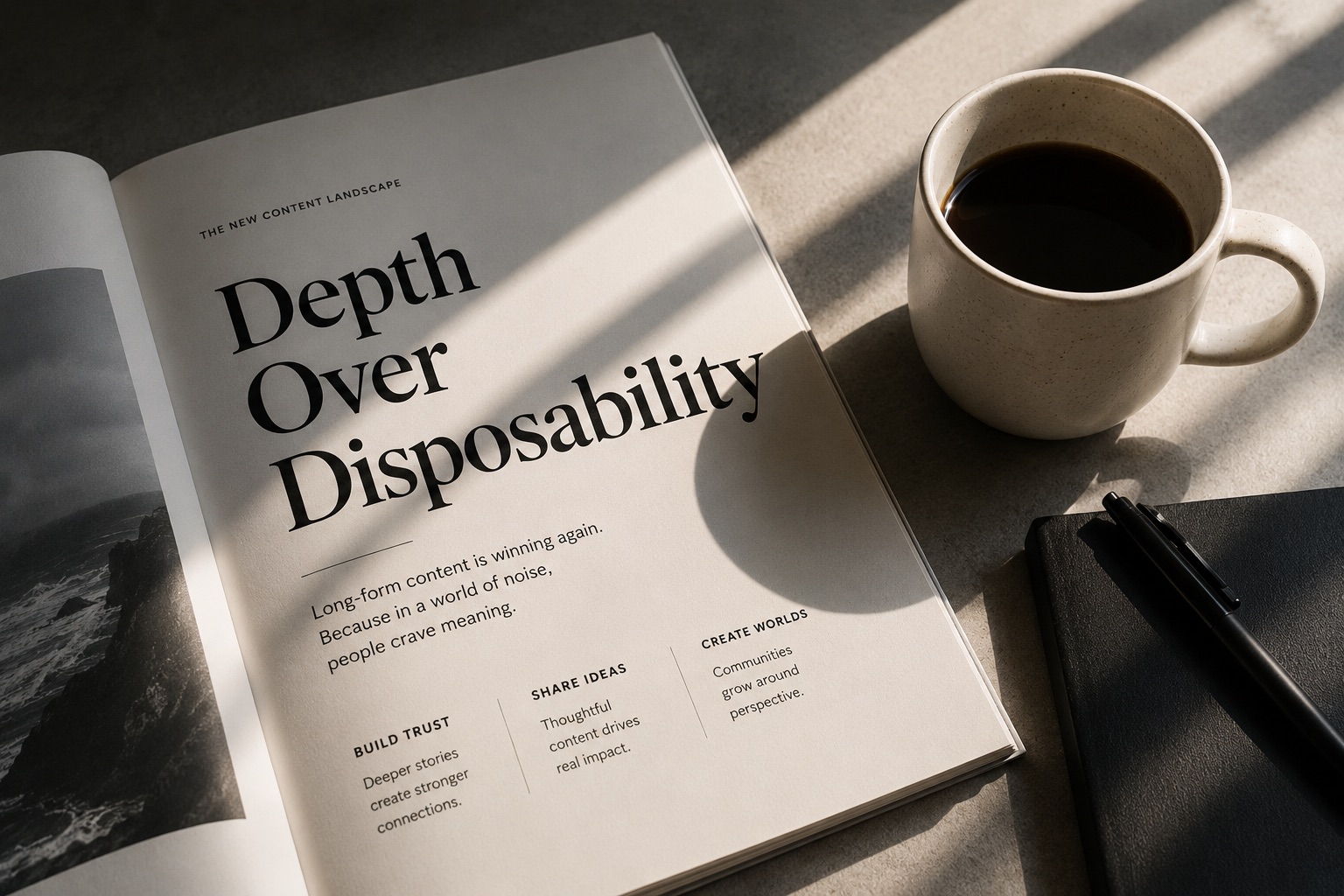
The Internet Spent Years Rewarding Speed
For the last decade, content strategy revolved around one thing: attention. Brands optimized for shorter videos, faster hooks, quicker captions, and constant visibility because algorithms rewarded content that could capture users instantly. The assumption was simple. If people stopped scrolling, the content was successful.
That model created an internet dominated by short form media. TikTok accelerated consumption habits. Instagram prioritized immediacy. Brands became obsessed with virality because reach appeared to be the ultimate measure of relevance.
But in 2026, audiences are beginning to push back against the endless cycle of disposable content.
People are still consuming short form media, but they are increasingly searching for something deeper. They want perspective instead of performance. They want substance instead of repetition. Most importantly, they want content that feels intentional rather than algorithmically engineered.
That shift is quietly reshaping the digital landscape.
According to Reuters Institute’s Journalism, Media and Technology Trends and Predictions 2026, publishers and creators are increasingly prioritizing more “distinctive” and human-centered storytelling because audiences are growing fatigued by AI-generated saturation and low-value content. Reuters Institute’s 2026 Media Trends Report
Why Short Form Content Creates Attention But Not Loyalty
Short form content is extremely effective for discovery. It can introduce audiences to a creator, product, or brand within seconds. That speed is powerful, especially in an increasingly crowded digital environment.
The problem is that attention and loyalty are not the same thing.
Most short form platforms are designed around interruption. Users scroll rapidly, consume content passively, and move on immediately. A video may generate millions of views while creating almost no meaningful relationship between the audience and the brand behind it.
That is why so many companies are experiencing the same frustrating pattern. They are posting more content than ever before while simultaneously struggling to build genuine audience connection.
Visibility alone does not create trust.
Long form content operates differently because it asks audiences to stay rather than simply react. A thoughtful article, podcast episode, newsletter, or founder essay creates space for ideas to develop. Instead of competing for milliseconds of attention, long form communication rewards expertise, storytelling, clarity, and emotional intelligence.
In many ways, long form content feels more human because it creates depth rather than fragmentation.
Vox recently explored how the internet’s obsession with clips and bite-sized media is changing the way audiences engage with journalism and thoughtful storytelling. The article argues that constant short form consumption may actually undermine nuance and long-term audience investment. Vox on the Impact of Short Form Culture
The Return of Newsletters, Podcasts, and Slow Media
One of the clearest signs of this shift is the rapid growth of newsletters, podcasts, and long form creator platforms.
Audiences are becoming increasingly selective about where they spend their attention. Instead of consuming endless streams of disconnected content, many consumers are gravitating toward media experiences that feel more focused and intentional.
This explains the rise of Substack culture, niche podcasts, independent essays, and long form YouTube channels. These formats allow creators and brands to build direct relationships with audiences without relying entirely on algorithms.
Beehiiv’s State of Newsletters 2026 report describes newsletters as becoming “the center of the content economy” because they give creators ownership over their communities and allow brands to build long-term audience relationships. beehiiv State of Newsletters 2026
The appeal of long form content is not simply about length. It is about intentionality. Audiences are looking for creators and companies that offer perspective, expertise, and consistency in a digital environment overwhelmed by noise.
That is why thoughtful communication is becoming a differentiator again.
Why Depth Is Becoming a Competitive Advantage
The internet has made content creation more accessible than ever. Almost anyone can create posts, replicate trends, or generate captions at scale. Artificial intelligence has accelerated that even further.
As a result, surface level content is becoming increasingly commoditized.
Depth, however, is difficult to replicate.
Depth requires original thinking, experience, perspective, and clarity. It demands a stronger point of view and a deeper understanding of the audience being served.
That is exactly why it has become valuable.
In a market flooded with repetitive content, brands capable of communicating meaningful ideas immediately stand apart. They are not just generating impressions. They are building authority.
Forbes recently argued that trust is becoming one of the most valuable currencies in the creator economy because audiences are prioritizing credibility and authenticity over visibility alone. Forbes on Trust in the Creator Economy
The strongest brands today are not necessarily the brands producing the most content. They are the brands creating the most meaningful content.
The Smartest Brands Are Building Worlds Instead of Posts
The brands quietly winning right now do not feel like content machines. They feel like ecosystems.
You enter their world through a newsletter, a podcast, a founder essay, a long form YouTube series, or a recurring philosophy that shapes everything they create.
Over time, audiences begin to understand not only what the brand sells, but how the brand thinks.
That distinction matters because modern consumers are increasingly drawn toward brands with identity, perspective, and emotional resonance. They are looking for something deeper than constant promotion.
Vogue recently reported that many luxury and fashion brands are intentionally moving away from aggressive viral marketing strategies in favor of slower, more immersive storytelling experiences that feel more authentic to audiences. Vogue on the Shift Away From Viral Marketing
The most effective content strategies in 2026 are not built around chasing trends. They are built around building trust.
Long Form Content Is Becoming Premium Again
Short form content is not disappearing. It will continue to dominate discovery and visibility online. But visibility is no longer enough to sustain meaningful brand growth.
As audiences become more overwhelmed by low-value content, depth becomes more powerful.
Long form communication creates loyalty because it gives people a reason to invest attention rather than simply consume it. It creates emotional connection, authority, and long-term brand equity in ways that short form content often cannot.
The future of content marketing will belong to brands people genuinely want to spend time with. Brands that teach instead of interrupt. Brands that communicate with intention instead of chasing algorithms. Brands that create substance instead of simply creating noise.
Attention may start the conversation.
But depth is what keeps people coming back.