A good product sampling agency shows you a sample goal written before the campaign and the delivered count beside it, aimed at a named audience. Ask for both numbers from a past program. On Kellogg's Krave, MOGXP set a goal of 250,000 samples and delivered 300,000.
That is the whole test. Most agency pitches skip it and lead with photos, a crowd and a branded truck. Those tell you the agency can stage an event. They say nothing about whether the product landed in the right hands.
What should a product sampling agency show you before you sign?
It should show you a goal and a result for the same campaign, written down. If an agency can only show impressions, photos or "engagement," it never committed to a number, which means you can't hold it to one.
Free samples are cheap to hand out and easy to waste. Sampl points to a Gartner survey that found 53% of marketers are under more pressure than before to explain or justify their decisions. A sample count against a goal is the simplest number you can walk into that conversation with.
So get the sample goal and the delivered count from a past program in writing. Get the name of the audience the samples were meant for, and how the team made sure they reached those people. And find out how the agency will report on your program while it is still running, not six weeks after.
Does handing out more samples mean a better campaign?
No. A count only means something when the people receiving the samples are the people who buy your product. Ten thousand samples to the wrong crowd is a cost. The same ten thousand to your buyer is a launch.
We've written before about why a brand activation drew a crowd and moved no product. Sampling fails the same way. The table is busy, the team is smiling, and nobody in line was going to buy the product anyway.
The fix is to decide who you are sampling before you pick a venue. That is where the method behind the agency matters more than the size of its fleet.
How does the Krave result show what targeting looks like?
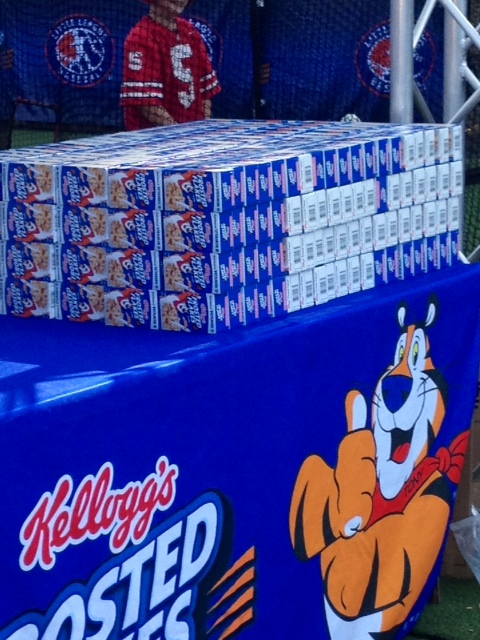
On the Kellogg's Krave launch, we set a sample goal of 250,000 and delivered 300,000 targeted samples. Look for that pairing in any agency's case study.
The targeting is what made the number worth having. Krave is a Kellogg's cereal, and the audience we chose was adolescents between 9 and 14 years old. So we went where they play, compete and hang out, at local youth events large and small, and we built interactive games so the sampling felt like part of the day instead of an interruption.
The same program also aimed to grow the Krave Facebook community by 100,000, and it grew by 175,000.
That result is our own account of our own work. I'd expect any agency to walk you through theirs the same way, and I'd ask for the goal document, not just the recap slide.
What is the Super-Sampling anchor-city method?
Super-Sampling is how we decide where samples go when a brand wants national reach without spreading thin. We pick anchor cities with surrounding populations that give us more reach and flexibility. Then we target the niches inside those markets where your buyer already gathers, such as military bases, gyms, beaches and college campuses.
The point is engagement per dollar. A sample handed to someone at a gym, for a sports nutrition product, starts a different conversation than one handed to a passerby on a busy street. This is one piece of our Local Impact Marketing approach, which starts by finding the waste in a plan before the money goes out the door.
Scale is part of it too. Reaching that many markets at once only works when the city list was chosen on purpose.
When you interview an agency, ask what its equivalent is. You are listening for a way of choosing places and audiences that it can explain in a minute and repeat on your account. "We have great locations" is not a method.
What should you ask a product sampling agency?
Here is the short list I'd take into any first call. The middle column is what a good answer sounds like, and the last column is the answer that should slow you down.
| Question | A good answer sounds like | A reason to pause |
|---|---|---|
| What was the sample goal on your last program? | A number, and the delivered count next to it | "We focus on engagement" |
| Who were the samples for? | A named audience and the places chosen to reach it | "Anyone with foot traffic" |
| How do you choose markets? | A method it can explain in a minute | A list of cities with no reasoning |
| What do I see while it runs? | Reporting during the campaign, with room to adjust | A recap deck after it ends |
| What happens if the count falls short? | A plain answer about what changes | A change of subject |
| Have you turned down a brief? | A specific reason, such as wrong audience or no strategy | "We take everything" |
We cover a wider set of questions in five questions to ask before you hire an experiential marketing agency, and the table above is the sampling-specific version.
Every good answer in that middle column is specific and checkable. You can verify a goal, an audience and a method. You can't verify enthusiasm.
How do you know sampling actually worked?
You measure at more than one point along the way. Sampl's guide to proving sampling ROI says successful campaigns check their results at every stage, from first contact through purchase, and it gives a worked example. For a campaign with a £25,000 budget that generated £120,000 in immediate sales uplift and an estimated £30,000 in long-term revenue, the formula is (£120,000 + £30,000 - £25,000) / £25,000 = 5.6x ROI.
That is one vendor's illustration, not a benchmark for your category. Treat it as a template for the math. It counts immediate and later revenue separately and divides by what you spent.
Older research points the same direction on timing. A national survey by Arbitron and Edison Media Research, reported by Marketing Charts, found that 35% of respondents claimed they purchased the sampled product on the same day. It is a 2008 phone survey of self-reported behavior, so use it as a reason to measure early, not as a forecast.
More recently, iMP quotes Event Marketer's 2024 Experiential Benchmark Report, which says "81% of consumers said they are more likely to purchase a brand after receiving a free sample at an event or pop-up." That is stated intent, not measured sales. It is exactly why you want your own numbers on top of it.
What drives the cost of a sampling campaign?
A handful of things move the price more than anything else, and a good agency will name them before you ask. One Australian agency, D2C, lists the number of stores, campaign duration, staffing requirements and sampling format. It says costs "can start at $350 per shift, all inclusive," though that is a local retail figure and not a U.S. quote.
Venue is the line that surprises people. Evolve notes that a venue in Los Angeles can run $1,200 to $5,000 per day or more for the most luxurious spaces.
If your first reaction is "we don't have the budget," smaller targeted programs can return more per dollar than a big event, so don't rule yourself out before you see a quote.
| Cost driver | What to ask |
|---|---|
| Number of markets and events | How many are in the quote, and which are anchors? |
| Staffing | Who trains the ambassadors, and who is on site? |
| Production and venue | What is included, and what is billed separately? |
| Program length | Is there a minimum, and what happens if you extend? |
Ask every agency, us included, to put that structure in writing before you compare quotes.
What are the common mistakes when hiring a sampling partner?
Buying the booth before you have a plan is the one I see most. A sponsorship or a table with no activation plan behind it gets you a presence, not product in hands, and if your last event looked great and sold little, that is probably what happened.
Recap decks cause the next problem. Photos show what the agency did, but your goal was about what the audience did afterward, so ask for the original goal and compare the two.
Price per sample can mislead you as well. A low cost per sample sounds efficient until you notice nobody in the line would have bought the product. Cost per sample to the right person is the number that matters, and it is harder to calculate, which is why agencies tend to avoid it.
Hurry does its own damage. Skipping the strategy conversation because the launch date is close gets you execution with no plan underneath, and activity is easy to buy.
Some owners write sampling off altogether because they sell services. I hear "we sell services" a lot, and it's a fair worry. A small service can be sampled through a demonstration or a short hands-on experience.
FAQ
What is product sampling in marketing?
Product sampling means giving people a small amount of your product to try before they buy. iMP describes it as a strategy where brands give consumers a free product to try. It usually happens at high-traffic places, events, gyms, offices and in stores.
Is experiential marketing still a thing?
Yes, and sampling is one of its most measurable forms. People get the product in their hands and you can count what happened. The catch is that it only works when someone planned the audience and the place first, which is the part of the job brands tend to skip.
What is a sample product called?
Most people call it a free sample, a trial size or a freebie. In the trade you will also hear "sampling units" or "trial packs." Whatever the name, the useful question is how many reached your buyer, not how many left the table.
What is a sampling event?
A sampling event is any planned moment where trained staff give people your product to try, such as a festival booth, a campus visit, a gym partnership or a truck stop in a city. A good one has a goal, a target audience and someone counting.
What to do today
I'll tell you honestly whether a sampling program makes sense for your product, your audience and your budget.