Most event budgets are spent in the wrong order. The venue gets booked, the date gets set, the build gets approved, and only then does anyone ask whether your buyers pass through that space on that day. By that point the money is locked, and the best you can do is report on a crowd.
Event experiential marketing is the practice of putting your product in people's hands at a live event, so they try it instead of just seeing it. What still surprises me is how many brands can tell me their attendance to the person and can't tell me how many people actually held the product. If you market a consumer or CPG product, that gap costs you. It sits inside our wider work on experiential marketing, and it starts with the question most recap decks skip.
What should you check before you commit event money?
Check place, time, audience and message, in that order. If even one is off, the event underperforms no matter how good the build looks. We ask these before we talk about trucks, booths or budgets.
Put the questions in the table to an agency, a venue or your own team.
| Check | The question to ask | A warning sign |
|---|---|---|
| Place | Will people who buy this product actually walk through this spot? | The venue was chosen because it's big or famous |
| Time | What is happening at this spot at the hour we'll be there? | Nobody can say what the foot traffic looks like by hour |
| Audience | Who specifically are we trying to put the product in front of? | The answer is "everyone" or "families" |
| Message | Does what we say fit the moment the person is in? | The same script runs at every stop |
Read the warning signs column first. Each one describes a plan built around the venue or the calendar, and each tends to end in a recap with a good crowd and a thin sales story. If an agency can't answer a question from the table in plain words, you've learned something before any money moved.
Place comes first, and here is why
The place decides whether your target buyer is within arm's reach. A big venue with the wrong crowd gives you a good photo and no trial. A small, plain spot where your buyer already shops, works out or waits puts you in front of people who could actually buy.
So start from your buyer's week and leave the event calendar for later. Where do they buy this category? Where do they spend a free ten minutes? Those answers shortlist places before anyone pitches you a concept.
Walk through it on paper before you walk it in person. Pull the foot traffic by hour, note what else is nearby, and find out who else is sampling that week. A competitor with a table fifty feet away changes the math.
I'm a retired U.S. Army First Sergeant, and that background shapes how we plan. It sits inside Local Impact Marketing, the method we built at MOGXP. It asks where the audience will actually be and what will actually reach them, and it asks that before the spend is committed. Our guide to six steps to consider when planning an experiential marketing event walks through the sequence.
Time of day can matter more than location
Yes, the hour can outweigh the address. According to American Guerrilla Marketing, a sampling program positioned outside a fitness studio at 2 PM generates a fraction of the consumer contacts the same program generates at 6 AM or 7 PM, when the studio's peak classes are running.
The place didn't change in that example. Only the hour did. A table in the right spot at the wrong time is the same as a table in the wrong spot.
Timing also means lead time, and Snapbar, an event-photo platform, reports from its own booking data that the median lead time across thousands of activations is 28 days, with the middle half booking between two and about eight weeks out. That's one platform's data, so treat it as a rough benchmark. If you want the full picture of what planning takes, read how long experiential marketing takes to plan.
Audience: who exactly should be holding the product?
Your audience is the specific person who would buy your product if they tried it, and you should be able to describe them in one sentence. "Women 25 to 54" is a media-buying category. "Parents picking up kids from school who already buy a competing brand" is someone you can find on a Tuesday afternoon.
Live events earn a lot of goodwill. According to HubSpot, 80% of consumers say live events are the most trusted way to discover new products, and 77% report increased trust in a brand after interacting with it at one. That trust belongs to whoever is standing at your table, so it only turns into a sale when the person in front of you could actually buy. A tight audience definition is how you convert general goodwill into a trial.
This is also where a crowd gets confused with customers. A packed room with confetti and no product in anyone's hand is the exact failure we exist to fix. If a plan celebrates how many people will be there before it says who they are, push back.
Message: say it for the moment the person is in
Someone leaving a gym wants water and a seat. Someone walking a mall in December wants to get through a list. A script written at a desk three weeks earlier rarely survives contact with either.
Test your message by asking a staffer to explain the product in one sentence to a person holding a coffee, with about ten seconds to spare. If they can't, the message only works in a deck.
Keep the product itself in the frame. Tasting, holding, trying and buying are the actions you're paying for, and the message exists to start one of them.
How do you measure product movement, not just attendance?
Decide what you'll count before the event, and write it down next to the goal. Attendance and social posts are easy to collect, which is why recap decks lean on them. Product in hand and purchases afterward are harder to collect and far more useful.
| Measure | What it tells you | What it leaves out |
|---|---|---|
| Headcount or impressions | How many people were nearby | Whether anyone tried the product |
| Samples or product placed in hands | How many people actually engaged | Whether they bought afterward |
| Redemptions or trackable purchases | Who acted after the event | Sales that came without a code |
| Sales in the activation market versus a comparison market | Whether the area moved | Causes other than the event |
Notice how the first row is the one most decks lead with and the one that says the least. The last two rows take setup with your retail or e-commerce team, which is exactly why they get skipped.
You don't need every row. You do need at least one from the lower half, set up before doors open, because it can't be added afterward.
We get products in the hands of consumers, and then we count them. MOGXP puts marketing dollars where they move people, then proves it. That second half is the part most event plans leave out.
A workable goal might read like this: place 5,000 samples in the hands of lapsed buyers across three markets, then compare their sales against a market with no event. Treat that as an illustration and swap in your own product, count and markets.
A budget that can't show product moved is the first one cut when money gets tight. For the longer view on proving return, see how experiential marketing drives real ROI.
What does counting product in hand look like on a real program?
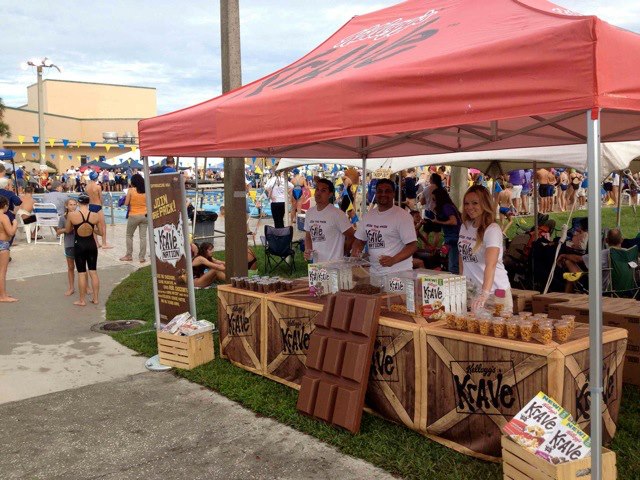
It looks like a number agreed in advance and a number reported at the end. On the Kellogg's Krave cereal launch, the goal was 250,000 samples and the program delivered 300,000. On the ISOPURE Amazon Treasure Truck program, 24 trucks ran in 24 cities in one day. On the Toyota Marine Corps boot camp challenge, the work produced more than 2,500 brand touches in eight hours.
Those counts show product and people reached. They don't show a sales lift, and we haven't published purchase data for them here, so we'd rather say so than imply it. If you want sales proof, set the purchase measure up at the start with your retail or e-commerce team, so the comparison exists when the event ends.
Repeat purchase is the number worth chasing past day one. Skift reports that around 70% of consumers become repeat customers after a great brand experience. That figure covers great experiences in general. Use it as a reason to look for repeat buyers, and don't read it as a forecast for your product.
Common mistakes
Booking the venue first is the one I see most. Once the date and the space are paid for, every later question about audience and timing turns into an argument for why the plan is still fine.
A big turnout feels like proof of success. Ask how many people held the product, and what happened to sales in that market over the following weeks.
Some teams wait until the event ends to pick a measure. By then the data was never collected, and the recap defaults to impressions.
On a small budget, you don't have to spend a lot on a big event or sponsorship, and smaller, targeted tactics sometimes return much more than larger ones.
Last, don't treat the event as one day. Follow-up and retargeting are where much of the return can sit, and our piece on why experiential marketing works even after the event ends covers how to plan for it.
Frequently asked questions
What is the definition of event marketing?
Event marketing is promoting a brand or product through a live occasion, in person or online, where people can interact with it. HubSpot says events can range from a roundtable of seven to 10 guests to a trade show exhibit.
What are some examples of marketing activations?
A product sampling table, a branded truck touring cities, a pop-up, or a hosted lounge. From our own work, examples include the ISOPURE Treasure Truck program across 24 cities and the Kellogg's Krave launch sampling.
How far ahead should I book an event?
Plan on several weeks. Snapbar's booking data shows a median of 28 days, and it advises that a large footprint should treat five weeks as a floor. Your own timeline depends on permits, production and staffing.
Can event experiential marketing work on a small budget?
Yes. Product demos, pop-ups and community events can work when they're aimed at the right buyer in the right place. Budget size matters less than whether place, time, audience and message line up.
What to do today
Take the next event on your calendar and write one sentence for each of the four checks: place, time, audience and message. If you can't write one, that's the gap to close before you spend more. Then add the one product-movement number you'll report, and who will collect it. If you want a second pair of eyes on the plan, ask us for a free discovery conversation and we'll go through the four checks together.