A sampling program can draw a long line and still move no product. What still surprises me is how many brands approve a sampling budget without writing down what the samples are supposed to do. The answer to that one question decides almost everything about how the program should be built.
What is product sampling, exactly?
A product sample is a portion of a consumer product handed to a person so they can try it before committing to a purchase, and Wikipedia describes it as a practice that is often free of charge.
That covers a lot of ground. A cracker on a toothpick in a grocery aisle is sampling, and so is a trial-size shampoo tucked into a mailing, a cold drink handed out from a truck, or a travel-size packet given to a college freshman crossing the quad in September. The format changes. The idea doesn't, because someone tries the product with their own hands, mouth or skin and forms their own opinion.
The same Wikipedia page says sampling matters most for non-durable goods such as food. Nobody knows whether they like a new cereal from a photo on the box.
Why does trying a product change what people buy?
Trial answers the questions an ad can only make claims about. A claim asks the shopper to take your word for it, and a sample lets them check the taste, the feel and the price against what they expected.
The numbers back this up, with a caveat. One sampling guide from Elev8 reports that "73% of consumers said they were more likely to buy a product after trying it , and nearly 85% of first-time purchases are influenced by samples ." Those are survey figures, so read them as a signal and not a promise.
The caveat matters because "more likely to buy" is an intention, not a sale. Look at how one UK program reports its results. Dig In, a student sampling company, reports that 89.9% of students said they were likely to buy Coca-Cola Original and Zero after sampling (n=3,019). That's a useful read on interest, but it doesn't tell you how many of those students walked into a shop and bought a can.
We've made the same point about launches before, in why experiential marketing works better for new product launches. A new product rarely fails because nobody saw it, it fails because nobody understood it, and trial fixes that faster than another round of ads.
What are the main ways to sample a product?
Sampling comes in a handful of formats, and each one fits a different job, so pick the format after you've picked the job.
| Format | How it works | Best suited to |
|---|---|---|
| In-store demo | A staffed table in a retail aisle offers a taste or trial at the shelf | Food and drink, where purchase is one step away |
| Event or street sampling | Trained ambassadors hand product to people in a chosen place | Launches that need volume in a specific market |
| Mail or digital request | Consumers ask for a sample online and it ships to them | Beauty, personal care and anything small and non-perishable |
| Campus or targeted group | Product goes to a defined audience, such as students | Brands chasing one age group |
The in-store demo has one big advantage, which is that the buyer is already standing in front of your product. Event and truck sampling buy you reach, but the shopper has to remember you later at the shelf, and that gap is where programs quietly lose their value.
We cover the planning side in what it takes to create effective product sampling campaigns and in effective product sampling initiatives.
When does product sampling actually pay off?
Sampling pays off when three things line up: the right person, the right moment and a way to count what follows. If any one is missing, you're giving product away.
A sample handed to someone who would never buy the product is wasted however good it tastes, and the more specific your audience, the more each sample is worth. Elev8's guide makes the same point when it says, "The more specific your targeting, the better the results." Timing works the same way, because a sample does its best work close to the decision to buy. A snack bar handed out at a gym on a Saturday morning is a different proposition from the same bar handed out at a concert at midnight.
The third piece is the one most programs skip. You need to decide before the event what a good result looks like. Samples delivered is the floor, while trial, repeat purchase and sales near the sampling location are the numbers that tell you whether it worked.
Budget is the usual objection at this point. You don't need a national tour to get this right, and smaller targeted tactics sometimes return more per dollar than larger ones, because every sample lands on someone who might buy.
What does a sampling program that worked look like?
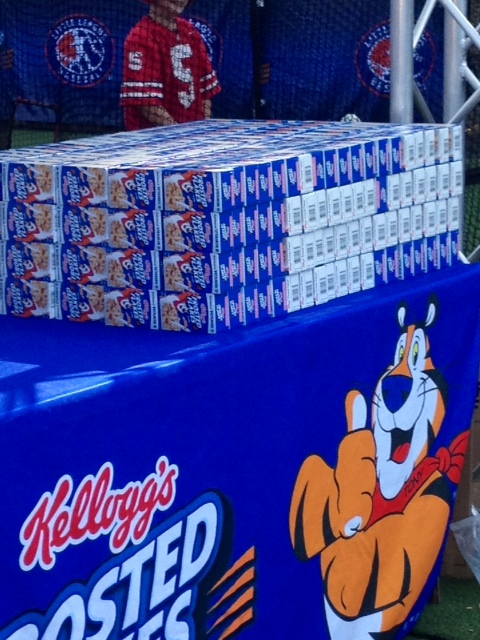
The clearest example we can point to is the Kellogg's Krave launch. Krave was a new chocolate cereal entering a category where, as our Kellogg's Krave case study puts it, consumers face over a thousand cereal choices every day. Kellogg's set a goal of 250,000 samples.
The original audience was, in the case study's words, more "spray and pray" than targeted. Our job was to micro-target the core consumer so that people didn't grab a sample and walk off, and instead stuck around, tried it and talked about it before they bought.
The campaign delivered 300,000 targeted samples against that 250,000 goal, and grew the brand's Facebook community by 175,000. The core audience was adolescents aged 9 to 14. The 300,000 weren't just any 300,000 hands, since they were samples aimed at a defined audience, and that is the difference between volume and a result.
When does sampling only draw a crowd?
Sampling draws a crowd and nothing more when the program is built to hit an attendance number. People love free things, so a table with a free product will always attract a line, but the line isn't the goal.
A packed table can still produce nothing if the people in it were never going to buy, if the sample was good but there was no way to find the product afterward, or if nobody tracked what happened to sales in the weeks that followed. It's the pattern behind a complaint we hear often from brand teams. The activation looked great, the photos were strong, and the sales numbers didn't move.
| Question | A program built to sell | A program built for a crowd |
|---|---|---|
| Who gets a sample? | A defined audience | Whoever walks past |
| Where does it happen? | Near where the product is sold, or where the buyer is | Wherever foot traffic is highest |
| What's measured? | Trial, repeat purchase, sales | Samples handed out, attendance |
| What happens after? | A clear step to find or buy the product | Nothing |
If most of your answers sit in the right-hand column, the program will probably produce a good photo and a thin result.
How do you know if a sampling program worked?
Start with delivery, meaning whether the samples reached the people you meant them to reach. Then look at the response from those people, and then at what they did next.
Dig In lays out a six-step framework for measuring sampling ROI, running from delivery proof to cost per trial. You don't need to adopt their method, but the logic is worth borrowing, because each measure answers a different question and none of them stands in for the others.
Samples handed out tells you how busy the team was. Survey intent tells you how people felt. Sales lift near the sampling site tells you whether the money moved product, and only that last one belongs in front of a CFO.
What are the common mistakes?
The most common mistake is choosing the format before the goal. A team sees a mobile tour that looks exciting and builds the plan around it, when a few well-placed in-store demos would have done the job for less.
The second is sampling everyone. It feels safer to hand product to every passerby, but it dilutes the program, because every sample that goes to a person outside your buyer is money spent on someone who was never going to purchase.
The third is leaving the sample with no next step. If the shopper loves the product and has no idea where to buy it, you've done the hard part and then dropped it, so pair the sample with a retailer name, a location or a coupon. The fourth is measuring only what's easy, since attendance and samples given are the two numbers that hide whether the spend worked. We explain how we build programs around that in Local Impact Marketing and product sampling.
FAQ
What is another word for a product sample?
Common alternatives include free sample, freebie, trial pack and trial size. Wikipedia lists "free sample," "freebie" and "trial packs" as other names for the same thing. Which one a brand uses usually depends on the product and the channel.
Is product sampling always free?
No. A sample is often free, but not always. Wikipedia notes that such samples "may or may not be free of charge." Some brands charge a small amount for a trial pack, which can also screen for more serious buyers.
Does product sampling work for every product?
It works best where trying the product settles the buying question, such as food, drink and personal care. It's harder for items that can't be tried in small portions. Even then, a hands-on demonstration can do the same job.
How is product sampling different from a giveaway?
A giveaway rewards entry, and the prize is often unrelated to what you sell. A sample puts your actual product in someone's hands so they can judge it. The first builds a list, and the second builds trial.
Can a service business use sampling?
Yes, in a different form. A small trial of a service, a hands-on demonstration or a hospitality lounge lets people experience the work before they commit. The principle is the same, because people still try before they decide.
What should you do this week?
Pull up your last sampling program and write down two numbers: how many samples went out, and how much product sold near those locations in the following month. If you can't find the second number, that's what to fix first.